Choosing the wrong virtual assistant company doesn’t just waste money; it quietly drains your most valuable resource: time. With the global virtual assistant market expanding rapidly, business owners face an overwhelming number of providers promising seamless support, expert talent, and flexible pricing.
Not every service delivers on those promises. The difference between a mediocre match and the right provider can mean hundreds of recovered hours per year, stronger customer relationships, and real business growth.
The 8 Best Virtual Assistant Companies
Narrowing down the best virtual assistant companies from a crowded, fast-evolving market takes more than a quick Google search. The eight providers featured here were evaluated across consistent dimensions: service model, pricing transparency, talent quality, specialization depth, security, scalability, and client support; so you can compare them on equal footing.
Editorial note: This guide is published by MyOutDesk, which is included in the comparison. Each provider was reviewed by service model, pricing transparency, talent quality, specialization, security, scalability, and client support, with an emphasis on matching different business needs to the right type of virtual assistant service. Provider details were checked against official company pages and reputable third-party coverage where available in April 2026, but pricing and packages can change.
Each company serves a distinct type of buyer. Some prioritize U.S.-based administrative support. Others are built for growing teams that need full-time global talent. A few specialize in executive assistance, managed pods, freelance marketplaces, or simple task-based delegation.
One practical distinction worth noting upfront: dedicated VA models (where one assistant works exclusively with you) differ significantly from shared or on-demand models in terms of consistency, context retention, cost, and ramp-up time. Both have real trade-offs depending on your workflow.
1. Belay – Best U.S.-Based Support
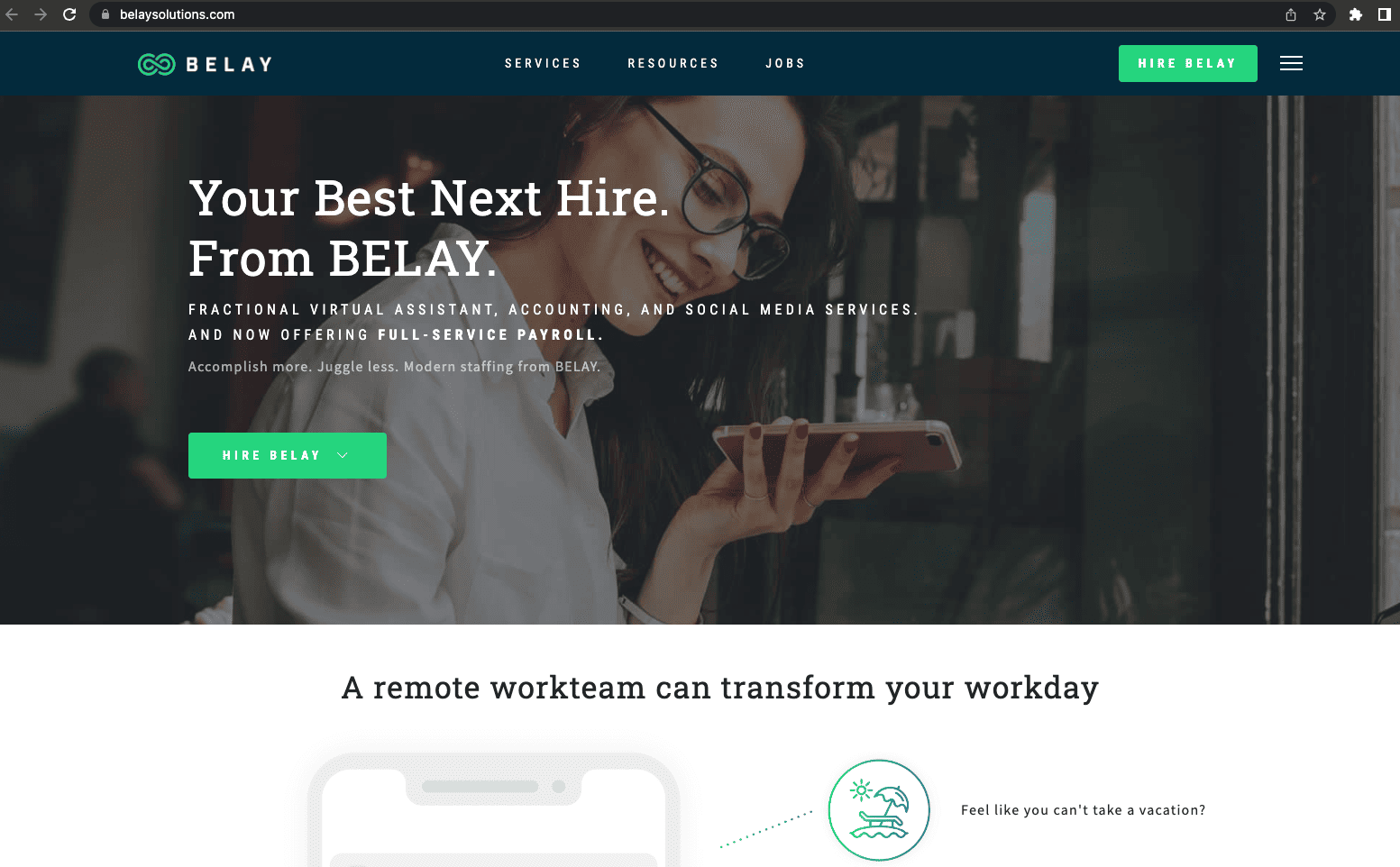
For companies that specifically want U.S.-based virtual assistant support, Belay is the clearest fit at the top of this list. The company emphasizes personally matched, U.S.-based assistants rather than an open marketplace or offshore staffing model, making it especially attractive for leaders who value time-zone overlap, communication familiarity, and a high-touch matching process.
Belay says it has matched more than 10,000 leaders across 50+ industries and selects assistants from the top 3% of vetted talent. Its service lines also extend beyond general administrative support into bookkeeping, accounting, and social media support, which makes it useful for small and mid-sized businesses that want several operational roles under one vendor relationship.
That positioning is why Belay earns the top spot here. It is not the cheapest option, and it is not the best fit for every global scaling plan, but it is one of the strongest choices for buyers whose first requirement is U.S.-based, professionally vetted support.
Pros
Belay’s biggest strength is its focused U.S.-based model. For leaders who delegate sensitive inbox, calendar, client communication, bookkeeping, or executive coordination work, domestic talent can reduce friction around business context, tone, and time-zone availability.
The matching process is also a meaningful differentiator. Belay does not simply hand clients a directory of candidates; it gets to know the client’s tools, communication style, priorities, and support needs before recommending a match. That matters for busy leaders who do not want to run a full hiring process themselves.
- Best fit: U.S.-based administrative, executive, bookkeeping, and social media support
- Notable proof points: 10,000+ leaders served, 50+ industries, and a stated top-3% vetted talent pool
- Support model: personal matching plus ongoing client success support
Cons
Belay’s premium positioning comes with trade-offs. Pricing is customized rather than published as a simple self-serve plan, so buyers need to speak with sales before making a precise cost comparison. U.S.-based support can also cost more than global staffing models, especially for companies that need full-time coverage or multiple assistants.
The model is also less compelling for teams that care more about global scale, cost efficiency, or industry-specific offshore capacity than domestic coverage. If your company needs several full-time remote professionals across sales, customer support, real estate operations, or back-office workflows, a global dedicated-staffing provider may offer a better capacity-to-cost ratio.
2. MyOutDesk – Best for Scaling Full-Time Virtual Teams

MyOutDesk is the strongest fit for businesses that want full-time, dedicated virtual professionals rather than fractional support or one-off task completion. The model is built around sourcing, vetting, onboarding, and integrating remote talent into a client’s existing tools and workflows, which makes it especially relevant for scaling teams in real estate, healthcare, finance, customer service, marketing, sales, and operations.
MyOutDesk’s public pricing starts at $1,988 per month, and the company states that it hires the top 0.7% of applicants, provides background checks, supports talent onboarding, and includes its proprietary MyTimeIn productivity tracking app. The company also publishes broader operating proof points, including 8,500+ clients served, 51+ industries, and global operations across the Philippines, Latin America, and Africa.
Pros
MyOutDesk’s main advantage is capacity. Companies can add dedicated VAs without taking on the recruiting, payroll, benefits, equipment, and office overhead associated with traditional hiring. That makes the service particularly useful when a business has repeatable work that needs consistent daily ownership rather than occasional task help.
The dedicated model also supports deeper workflow familiarity over time. Instead of re-explaining context to a rotating pool of assistants, clients can train one virtual professional around their CRM, inbox process, call scripts, reporting cadence, or customer communication standards.
Additional advantages include:
- Global talent coverage across APAC, LATAM, and Africa
- Proprietary productivity tooling through MyTimeIn
- Structured screening and onboarding for full-time virtual professionals
- Scalable role coverage across administrative, customer service, sales, marketing, real estate, finance, healthcare, and operations work
Cons
MyOutDesk is not the right fit for every business. The full-time dedicated model can be more commitment than a solopreneur or early-stage startup needs, especially if the workload is occasional, unpredictable, or limited to a few small tasks per month.
Buyers should also review contract terms, onboarding expectations, role scope, and security requirements before signing. For companies that only need ad hoc research, a few calls, or one-off scheduling help, a task-based service or freelance marketplace may be more flexible.
3. Athena – Best for Secure Executive Assistant Support

Athena deserves a high ranking for executives who want a full-time executive assistant with a strong security and operating wrapper. The company publicly lists a $3,000 per month executive assistant plan and says each EA is vetted, trained, device equipped, and employed by Athena.
The most defensible differentiator is security. Athena says every EA works on an Athena-issued secured laptop, with mobile device management, proactive monitoring, and remote-wipe capability. For founders, investors, and executives who delegate inboxes, calendars, documents, travel, vendor communication, and other sensitive workflows, that device and data model is a meaningful advantage.
Pros
Athena’s standout strength is its full-time executive assistant model. Rather than selling quick tasks or a marketplace of profiles, Athena focuses on dedicated EA relationships backed by matching, onboarding, performance management, and internal infrastructure.
- Device security: Athena-issued laptops, MDM controls, monitoring, and remote wipe
- Executive focus: calendar, inbox, travel, delegation, and strategic support workflows
- Operational backing: training, manager support, expert resources, and rematching support
Cons
Athena’s premium model is narrower than many businesses need. The service is built around full-time executive assistant support, so it is less flexible for companies that need part-time help, task-based work, bookkeeping, customer service, sales support, or multiple operational roles across departments.
The $3,000 per month price point also makes Athena a better fit for executives with enough recurring delegation volume to justify the cost. For companies that need broader team capacity or lower-cost full-time virtual professionals, MyOutDesk or another global staffing provider may be a better fit.
4. Prialto
Shifting from a domestic-focused model, Prialto takes a distinctly different approach to virtual assistant services: one built around managed teams rather than individual contractors. Instead of matching you with a single assistant, Prialto assigns a dedicated VA backed by an entire support layer, including engagement managers who oversee quality and continuity.
This structure is particularly well-suited to mid-market companies and executives who need reliable, process-driven support at scale. If an assistant is unavailable, a trained backup steps in seamlessly, a meaningful advantage over solo-assistant arrangements where coverage gaps can disrupt operations.
On the other hand, this managed-team model carries a premium price point that may exceed the budgets of solopreneurs or early-stage businesses. The tradeoff is reliability and consistency over cost efficiency.
Prialto’s strengths become clearer when evaluating it against the specific demands of enterprise-adjacent teams, which is exactly where the next company on this list carves out its own niche.
Pros
Prialto’s managed team model delivers some standout advantages for businesses that prioritize reliability over individual relationships. Because every client is supported by a team rather than a single assistant, coverage gaps from illness, vacations, or turnover essentially disappear, a meaningful distinction for executives who can’t afford workflow disruptions.
The service also invests heavily in onboarding and process documentation, building detailed playbooks around how each client operates. In practice, this means new team members can step in without requiring the client to re-explain preferences from scratch.
Prialto tends to attract organizations with complex, recurring administrative workflows: think executive scheduling across multiple time zones, CRM management, or ongoing inbox triage. For those use cases, the structured approach genuinely outperforms more flexible but less systematic alternatives. That structured depth, however, comes with its own set of limitations worth examining.
Cons
Prialto’s managed team model comes with real trade-offs worth considering carefully. The most significant drawback is cost – pricing starts around $1,500/month, placing it firmly out of reach for solopreneurs or small businesses watching every dollar. That investment buys reliability, but budget-conscious operators may find it hard to justify.
The team-based structure, while excellent for continuity, also means you won’t build a dedicated one-on-one relationship with a single assistant. For business owners who prefer a consistent personal dynamic – someone who deeply understands their communication style and preferences over time – this model can feel impersonal.
Additionally, Prialto focuses primarily on administrative and sales support tasks, which limits its appeal for clients needing specialized skills like graphic design, content creation, or technical work. If your needs extend beyond core business operations, you may need to look elsewhere – which is exactly where freelance-based platforms like Upwork enter the conversation.
5. Upwork
Upwork occupies a fundamentally different position from every other option covered so far. Rather than a managed VA service, it’s a freelance marketplace, meaning you’re directly hiring, vetting, and managing independent contractors yourself. That distinction shapes everything about the experience.
The platform hosts millions of freelancers across virtually every skill category, giving businesses rare flexibility to find highly specialized talent at a wide range of price points. Need a VA with niche industry knowledge or a specific software background? Upwork’s search filters make that possible.
However, the trade-off is significant: all quality control falls on you. There’s no account manager, no backup coverage, and no service guarantee. What you gain in flexibility, you absorb in management overhead.
Upwork works best for businesses that are comfortable running their own hiring process and want maximum control over who they bring on. That flexibility is useful, but it is very different from the managed and dedicated models above.
Pros
Upwork’s greatest strength is sheer scale and flexibility. With over 18 million registered freelancers spanning hundreds of skill categories, finding a VA with a highly specific background, whether that’s legal support, e-commerce operations, or multilingual customer service, is genuinely achievable. You’re not locked into a predefined service package.
Cost control is another standout advantage. Hourly rates can start as low as $5 to $15 for overseas talent, and you set your own budget per project or contract. For businesses with variable workloads, that flexibility is hard to beat.
The platform’s built-in tools (time tracking, contract management, and escrow-based payments) provide a solid layer of structure without requiring third-party software. You can also review verified work histories, client feedback scores, and portfolio samples before committing. However, those strengths come with notable trade-offs worth examining closely.
Cons
Upwork’s flexibility comes with real trade-offs. The vetting burden falls entirely on you. There’s no dedicated matching process, no quality guarantee, and no backup coverage if your VA disappears mid-project. Screening candidates, reviewing portfolios, and running test tasks all consume time that many business owners simply don’t have.
Service fees add up quickly. Upwork charges client marketplace or Business Plus fees on payments, and the exact fee can vary by plan and payment method. Hourly billing without built-in accountability also means tracking productivity often requires third-party tools or manual oversight.
In practice, turnover can also be a persistent headache. Freelancers juggle multiple clients simultaneously, meaning their availability and focus aren’t exclusively yours. For businesses that need consistent, long-term support rather than project-by-project help, a more structured VA service may ultimately deliver greater reliability, which is exactly the kind of dedicated model the next option takes a very different approach to.
6. Fancy Hands
Shifting from broad freelance marketplaces, Fancy Hands takes a fundamentally different approach, one built around task-based delegation rather than ongoing VA relationships. Instead of hiring a dedicated assistant, you purchase a bundle of tasks and submit requests as needed. It’s a model designed for business owners who need occasional help without committing to a monthly retainer or managing a freelancer directly.
How it works: You submit tasks through the platform, and an available assistant picks it up, typically within minutes during business hours. Common use cases include scheduling, research, data entry, phone calls, and travel bookings.
The task-based structure makes Fancy Hands one of the most affordable entry points in the VA space, appealing to solopreneurs testing delegation for the first time. However, because tasks rotate among multiple assistants, you won’t build continuity with a single person, a meaningful trade-off for anyone needing nuanced, context-aware support.
The platform’s strength is speed and simplicity; its limitation is that “simple” defines the ceiling for what it can reliably deliver.
That ceiling matters more as your business grows, which is exactly where the next provider on this list aims to step in.
Pros
Fancy Hands shines brightest when you need quick, discrete tasks handled without the overhead of a long-term commitment. There’s no hiring process to manage, no onboarding, and no monthly retainer eating into your budget during slow periods. You simply submit a request and a trained assistant picks it up, often within minutes during business hours.
The subscription model is refreshingly straightforward: pay for a set number of tasks per month, and unused requests roll over on some plans. For entrepreneurs juggling sporadic workloads, that flexibility is genuinely valuable. It’s also one of the more affordable entry points in the VA space, making it accessible for solopreneurs who aren’t ready to commit to dedicated assistant pricing.
Task variety is solid too: scheduling, research, data entry, and phone calls are all fair game. However, the real trade-offs emerge once you dig into the limitations.
Cons
The task-based model that makes Fancy Hands so convenient also introduces some notable limitations worth considering.
- No dedicated assistant: Each request is handled by whoever is available, meaning there’s zero continuity between tasks. Context has to be re-explained every time.
- Narrow scope: Complex, multi-step projects or anything requiring deep familiarity with your business simply don’t fit the model well.
- U.S. business hours dependency: Turnaround windows can stretch depending on task volume and timing, which isn’t ideal for time-sensitive work.
- Limited specialization: Tasks requiring niche expertise, such as bookkeeping or advanced social media strategy, are better handled by dedicated VA services.
In practice, Fancy Hands works best as a supplemental tool rather than a primary delegation solution, a sharp contrast to providers offering fully managed, ongoing support. If your needs are growing beyond quick, one-off tasks, a more relationship-driven VA service may be the smarter long-term investment, which is exactly what the next provider on this list delivers.
7. Magic
Magic occupies a unique space in the virtual assistant landscape by positioning itself as an on-demand, text-based concierge service that connects users with assistants around the clock. The premise is simple: send a text, get it done.
Where Magic differentiates itself is speed of response and broad task scope. Users can delegate everything from research and scheduling to travel bookings and data entry without navigating a complex onboarding portal. The interface is deliberately frictionless, a selling point for executives and entrepreneurs who need help immediately rather than eventually.
In practice, Magic functions best as a reactive support tool rather than a proactive strategic partner. It handles bursts of demand well, but the lack of a dedicated assistant, similar to the limitation noted with task-based models, means context doesn’t always carry between sessions.
That said, Magic’s 24/7 availability and minimal setup requirements make it worth considering for fast-moving teams. The next provider on this list takes a distinctly different approach to assistant matching.
Pros
Magic’s text-first approach delivers a surprisingly frictionless experience for users who prefer minimal setup and maximum flexibility. A few standout advantages make it worth a serious look:
- Zero onboarding friction: There’s no lengthy intake process or matching period. Send a text and a task is already in motion.
- True 24/7 availability: Unlike many services that operate within standard business hours, Magic connects users with live assistants around the clock, making it practical for entrepreneurs across multiple time zones.
- Remarkably broad task scope: From restaurant reservations and travel bookings to research and scheduling, the range of tasks Magic handles is wide by design.
- No long-term commitment required: Pay-as-you-go flexibility means occasional users aren’t locked into monthly minimums.
In practice, this model works exceptionally well for busy professionals who need sporadic but immediate support. That said, Magic’s structure also introduces some real trade-offs worth examining closely.
Cons
Magic’s on-demand model comes with real trade-offs worth considering before committing.
- Unpredictable pricing: Because billing is task-based rather than subscription-based, costs can escalate quickly during busy periods, making budgeting genuinely difficult for cost-conscious businesses
- No dedicated assistant: Each request may be handled by a different team member, which limits relationship-building and means assistants lack accumulated context about your preferences or working style
- Limited specialization: Magic performs best with general concierge-style tasks. Complex, domain-specific work, such as advanced bookkeeping, technical research, or industry-specific project management, falls outside its core strengths
- Text-only interface: While frictionless for some, the SMS-first format can feel restrictive for users who prefer structured workflows, dashboards, or direct voice communication
In practice, Magic suits users who need quick, ad hoc support rather than a consistent, integrated assistant relationship. Teams requiring deep specialization or predictable monthly costs may find the model less sustainable long-term. That gap between flexibility and structure is exactly where the next contender on this list takes a very different, and highly deliberate, approach.
8. WoodBows
WoodBows positions itself as a reliability-focused virtual assistant service built around consistent, long-term support rather than one-off task completion. Where on-demand models like the previously reviewed provider introduce unpredictability, WoodBows takes the opposite approach, pairing clients with dedicated assistants trained across a broad range of business functions.
Key strengths include:
- Dedicated assistant model: Clients work with the same VA consistently, reducing ramp-up time and improving output quality over time
- Broad skill coverage: Support spans administrative tasks, customer service, research, and basic marketing functions
- High client retention rates: The service emphasizes long-term relationships over transactional engagements
In practice, businesses that need a reliable daily workflow partner tend to find this model more sustainable than rotating task pools. The consistency factor alone can dramatically reduce the time spent re-explaining preferences and processes.
On the other hand, WoodBows may not suit teams needing highly specialized technical skills or enterprise-scale capacity on short notice. It fits best when reliability outranks raw horsepower. The next provider on our list brings a different angle, one worth considering if specialized expertise is your top priority.
Pros
WoodBows has built a reputation around something that frustrates many users of other services: consistency. Rather than routing tasks through rotating pools of assistants, WoodBows pairs clients with a dedicated virtual assistant who learns their preferences, communication style, and workflows over time.
- High client retention: The dedicated model naturally encourages long-term relationships, reducing the onboarding friction that comes with assistant turnover
- Broad skill coverage: Assistants handle everything from administrative scheduling to customer support and research tasks
- US-based and international options: Clients can choose their preferred assistant tier based on budget and task complexity
- Straightforward pricing: Flat-rate plans make monthly budgeting predictable, a meaningful advantage over task-based billing models
In practice, businesses that rely on ongoing, process-heavy support tend to get the most value here. The continuity factor alone can save hours of repeated briefing and context-setting. However, like most dedicated-assistant models, WoodBows comes with trade-offs worth examining closely.
Cons
WoodBows’ strengths come with notable trade-offs worth considering. The dedicated-assistant model means pricing runs higher than on-demand or hourly alternatives, a real constraint for solopreneurs or early-stage businesses watching every dollar. Plans also require a minimum commitment, so flexibility is limited if your workload is inconsistent month to month.
Because WoodBows focuses on a defined scope of administrative and business support tasks, clients needing highly specialized skills (advanced data analysis, technical development, or niche industry expertise) may find the offering too narrow. Onboarding a new assistant still requires an investment of time upfront, even with the dedicated model.
Coverage during assistant absences can also feel less seamless compared to larger staffing networks. For businesses that need round-the-clock or on-demand surge support, the structure may not fully align with those demands, a factor the upcoming comparison chart will help put into clearer perspective.
Virtual Assistant Company Comparison Chart
| Virtual Assistant Company | Best For | Pricing | Advantages | Disadvantages |
| Belay | U.S.-based support | Custom quote | U.S.-based talent Personal matching Client success support Multiple service lines | Premium pricing No simple public package price Less cost-efficient for full-time global scale |
| MyOutDesk | Scaling full-time virtual teams | Starting at $1,988/month | Dedicated full-time VAs Global talent coverage MyTimeIn productivity tooling Broad role coverage | More commitment than ad hoc support Contract terms require review Best for recurring workloads |
| Athena | Secure executive assistant support | Starting around $3,000/month | Athena-issued secured devices Dedicated full-time EA Executive focus Operational support | Premium pricing Narrow executive-assistant scope Less flexible for part-time or multi-role needs |
| Prialto | Managed assistant pods | Starting at $1,500/month for 55 hours | Engagement manager Backup VA coverage Flat-rate pricing Process-driven support | High entry cost Admin and sales scope only 90-day minimum Setup fee may apply |
| Upwork | Freelance marketplace flexibility | Free to join; client service fees apply | Huge talent pool Flexible scaling Transparent ratings No long commitment | DIY vetting Variable quality Stacked service fees Self-managed |
| Fancy Hands | Simple task-based requests | Request-based plans; standard requests up to 20 minutes | Low-friction task submission Pay-per-task model No hiring process Good for small asks | Rotating assistants Short task cap Limited continuity Simple admin tasks only |
| Magic | Fast on-demand or dedicated assistant support | Starting around $270/week for 20 hours | 24/7 availability Quick matching Dedicated option No long contract | Weekly billing Variable fit by task Limited specialization Less process depth |
| WoodBows | Budget-conscious dedicated VA plans | Starting around $899/month for 40 hours | Dedicated VA Flat-rate plans Account manager International and U.S.-based options | Mixed public plan details Limited specialization Quality may vary by tier |
Pricing structures vary significantly: hourly models offer flexibility for unpredictable workloads, while dedicated arrangements provide consistency for established operational needs. When evaluating options, consider whether specialized industry knowledge or broad administrative capability aligns better with your specific business requirements and growth trajectory.
Choosing the Best Virtual Assistant Company for Your Business in 2026
With the comparison chart providing a clear side-by-side snapshot, the real decision comes down to fit over features. No single provider is universally best. The right choice depends on your workflow, budget, and growth stage.
A few practical filters help narrow it down quickly:
- Budget-conscious teams benefit most from flexible, on-demand or hourly models
- Executives needing consistency should prioritize dedicated-assistant services
- Specialized tasks (like bookkeeping or social media) call for niche-focused providers
- Scaling businesses need a provider with documented onboarding and replacement processes
According to Wing Assistant, the most in-demand VA skills in 2026 span administrative support, content creation, and customer communication, meaning task scope should drive your shortlist, not brand recognition alone.
The best virtual assistant company is simply the one that removes friction from your specific operations. With that principle in mind, the next step is straightforward: matching your top priorities to a concrete recommendation.
Virtual Assistant Services? Any Recommendations?
After weighing every factor covered throughout this guide (pricing, specialization, scalability, and cultural fit), the honest answer is: the best recommendation depends entirely on your workflow. That said, a few clear patterns emerge.
For growing small businesses that need reliable administrative support, a managed-placement service with U.S.-based assistants tends to deliver the smoothest onboarding. For startups watching burn rate closely, subscription-based models offering dedicated hours provide predictable costs without surprise invoices.
One practical approach is to start narrow: identify your single most time-consuming recurring task, then choose a provider built around solving exactly that. Avoid over-engineering the decision by chasing every feature.
According to Hire in South, inbox management, scheduling, and social media support remain the most in-demand virtual assistant services heading into 2026, meaning most established providers handle these competently.
Still have specific questions about pricing tiers, contract terms, or how to vet candidates? The next section addresses the most common ones directly.
Frequently Asked Questions
What’s the average cost of hiring a virtual assistant?
Virtual assistant pricing typically ranges from $10 to $75 per hour depending on experience level, specialization, and whether you hire through an agency or independently. Entry-level administrative support starts around $10-$20 hourly, while specialized VAs for bookkeeping, marketing, or technical tasks command $30-$50 per hour. Premium executive assistants with industry expertise can exceed $75 per hour. Monthly retainer packages often provide better value for ongoing support needs.
How do virtual assistant companies vet their candidates?
Reputable companies implement multi-stage screening processes including background checks, skills assessments, reference verification, and behavioral interviews. One common pattern is requiring candidates to pass industry-specific tests before entering talent pools. Many providers also conduct criminal background checks and verify work history spanning 7-10 years to ensure reliability and trustworthiness for clients handling sensitive business information.
Can virtual assistants work in my specific industry?
Most established virtual assistant companies offer industry-specialized talent across sectors including real estate, healthcare, legal, finance, and e-commerce. However, highly regulated industries like healthcare may require additional compliance training or certifications. What typically happens is providers match assistants with relevant industry background to your business, ensuring they understand sector-specific terminology, workflows, and compliance requirements from day one.
How quickly can I get started with a virtual assistant?
Onboarding timelines vary by provider complexity, ranging from same-day placements for basic tasks to 2-3 weeks for specialized roles requiring extensive matching. A practical approach is allowing one week for initial consultations, skill matching, and assistant orientation. Rush placements are possible but may limit candidate selection quality and cultural fit assessment opportunities.
About The Author

Steve Young is a marketing executive with 20 years of experience across B2B SaaS, outsourcing, HR tech, fintech, cybersecurity, and consumer electronics. He specializes in performance marketing, GTM strategy, and revenue operations, with a track record of building programs from the ground up and scaling them globally across North America, EMEA, and APAC. He currently leads demand gen at MyOutDesk.
Related Posts
-
 Hiring
25 Virtual Assistant Statistics To Help Scale Your Business Faster In 2026
Discover the most important virtual assistant statistics for 2026, from cost savings and productivity gains to how modern businesses are scaling with remote talent.
Read more -
 Hiring
How To Hire a Virtual Assistant: The Complete 2026 Guide
Unlocking the benefits of hiring a virtual assistant can transform your business. From cutting costs to boosting productivity and enhancing flexibility, a skilled virtual assistant is a game-changer for achieving your goals. Ready to make the leap? If you’ve decided that a virtual assistant is the right solution to elevate your business, it’s time to focus on making your first hire a resounding success. The key? Hiring the right virtual assistant for your needs.
Read more -
 Hiring
Blended Business Model: Integrating Remote Workers, Virtual Assistants & In-Office Staff
The modern workforce is blended—uniting in-office staff, remote employees, and virtual assistants into one high-performing team. Learn why more companies are adopting this model, common pitfalls to avoid, and how to implement it successfully.
Read more -
 Hiring
The 6 Best Real Estate Virtual Assistant Companies – 2026 Update
Enhance your business with insights highlighting the best real estate virtual assistant companies. Discover tailored solutions to streamline operations, optimize client interactions, and drive success in the competitive real estate market.
Read more -
 Hiring, Virtual Assistants
Top Tools for Measuring Employee Satisfaction in 2026
These are the most effective employee satisfaction measurement tools that help organizations understand how their teams feel and identify areas for improvement.
Read more -
 Healthcare, Hiring, Virtual Assistants
Executive Insights: Solving The Healthcare Talent Shortage with Virtual Teams
The healthcare industry in the United States is grappling with a severe talent shortage that threatens the quality and accessibility of patient care. According to the Association of American Medical Colleges (AAMC), the US could face a deficit of approximately 139,000 doctors by 2033. Additionally, the US Department of Health and Human Services reports that … Read more
Read more -
 Hiring
Outsourcing To The Philippines: Pros, Cons & More
The Philippines is one of the top destinations where major corporations outsource their business needs too, allowing businesses to keep overhead down on expenses such as office space, equipment, internet connection, taxes, and even benefits.
Read more -
 Hiring
The 5 Best Virtual Receptionist Services of 2026
Discover 5 leading virtual receptionist service options in MyOutDesk’s comprehensive guide. Explore how these services can revolutionize your business communication, providing efficiency and professionalism for unparalleled customer interactions.
Read more -
 Hiring
Fiverr vs. Upwork: Comparing Workflow, Cost, and Freelance Talent For Your Business
Unsure about Fiverr vs. Upwork? MyOutDesk’s blog delves into the comparison, offering insights to help you choose the right freelance platform for your projects. Make informed decisions and maximize your freelancing opportunities with this comprehensive guide.
Read more -
 Hiring
The 8 Best Upwork Alternatives of 2026
Exploring options beyond Upwork? MyOutDesk’s blog offers valuable insights into the 8 best Upwork alternatives. Find tailored platforms with solutions to suit your business needs and achieve new levels of growth and success.
Read more -
 Hiring
What Is a Hybrid Business? Definition, Benefits, Examples, and More
By blending in-house teams with outsourced virtual assistants, businesses are optimizing productivity and cost-effectiveness. Common among US corporations, this approach bolsters operational efficiency, cost reduction, and business growth. With perks such as improved flexibility, cost savings, and amplified efficiency, firms like MyOutDesk offer specialized virtual assistant services to help businesses maximize these benefits.
Read more -
 Hiring
Freelancer vs. Virtual Assistant: What’s The Difference?
Virtual assistants and freelancers can both provide services remotely, but there are key differences in their work arrangements, pricing, and availability. When deciding between the two, consider your budget, the complexity of the work, and whether you want a dedicated or ad hoc resource.
Read more